Emirates Group Posts AED4.1 Billion Half-Year Profit, Down 66% as Conflict and Fuel Costs Bite
The Emirates Group posted a half-year profit before tax of AED4.1 billion, down 66%, as regional conflict and doubled jet fuel prices hit earnings.
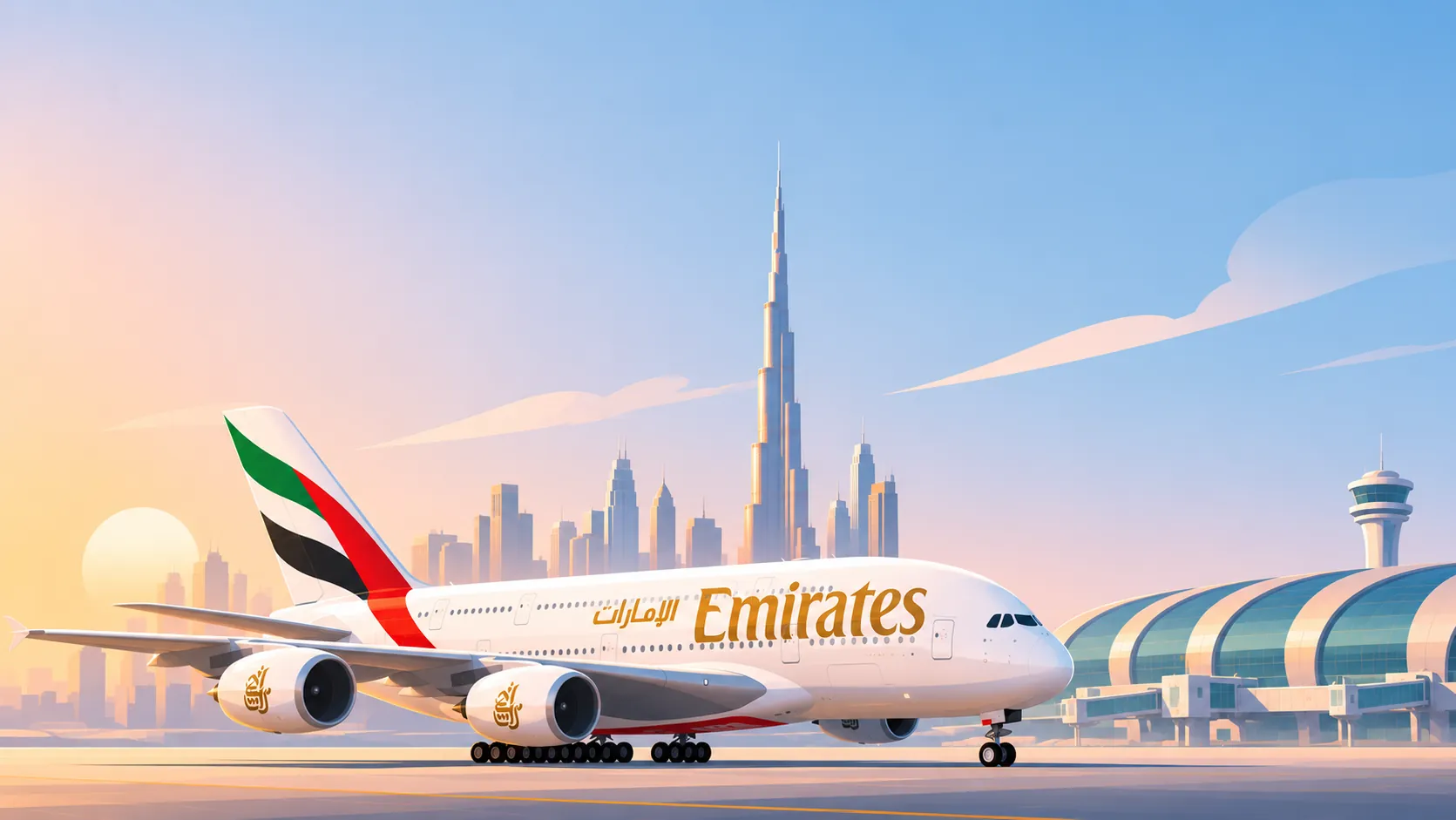
The Emirates Group has reported a 66% fall in half-year profit as the regional conflict, soaring fuel costs and disrupted air travel weighed on Dubai's largest aviation business. Announced on 5 November 2026, the results show a profit before tax of AED4.1 billion (US$1.1 billion) for the six months to 30 September, against AED12.2 billion in the same period last year, which was a record. Revenue fell 12% to AED66.2 billion.
The Group, which includes Emirates airline and the aviation services provider dnata, stayed profitable through what its chairman called a demanding six months.
The Group's numbers at a glance
| Indicator | First half of 2026-27 | Change |
|---|---|---|
| Profit before tax | AED4.1 billion | Down 66% |
| Profit after tax | AED3.6 billion | Down 66% |
| Revenue | AED66.2 billion | Down 12% |
| EBITDA | AED12.5 billion | Down 41% |
| Cash balance | AED54.1 billion | Down from AED59.6 billion at 31 March 2026 |
The Group said it drew on its cash reserves to cover aircraft pre-delivery payments and debt servicing, and it paid the remaining AED2 billion of the AED3.5 billion dividend declared for 2025-26 to its owner, the Investment Corporation of Dubai. Headcount stood at 128,237 on 30 September, 2% lower than at the end of March.
Sheikh Ahmed bin Saeed Al Maktoum, Chairman and Chief Executive of Emirates airline and Group, said customer demand held firm and cargo made a strong contribution, even as global jet fuel prices doubled. He thanked the UAE government for coordinating the safe resumption of air transport after military activity across the Gulf region, and said the Group enters the second half with measured optimism.
Emirates airline: a smaller operation, a much smaller profit
Emirates airline reported a profit before tax of AED3.7 billion, down 68% from AED11.4 billion a year earlier. Its profit after tax was AED3.3 billion, down 66%, and revenue fell 13% to AED56.9 billion.
The company said intermittent airspace restrictions and closures across the region, along with government travel advisories, reshaped travel flows. Bloomberg and other outlets link the disruption to the Iran war. By 30 September, Emirates was operating 91% of its pre-disruption network, serving 150 airports in 78 countries and territories.
Traffic was sharply lower:
- Passengers: 21.8 million carried between 1 April and 30 September, down 22%.
- Capacity: available seat kilometres fell 17%, and overall capacity in tonne kilometres fell 10%.
- Seat factor: 72.0%, down from 79.5%.
To rebuild confidence, the airline introduced an industry-first travel cover that is not restricted by government travel advisories, free date changes and generous refund policies. Premium cabins continued to see strong demand.
Fuel: the biggest cost hit, cushioned by hedging
Global jet fuel prices roughly doubled compared with the same period last year. Emirates burned 12% less fuel as flying was cut, yet its fuel bill before hedging rose 60%. Gains of AED7.1 billion from its fuel price risk management programme brought the net increase down to 13%. Fuel remains the largest cost for the airline, at 34% of operating costs.
Total operating costs fell only 2%, broadly in line with the reduction in operations.
Cargo: the bright spot
Emirates SkyCargo carried 1.2 million tonnes, down just 1%, but cargo revenue jumped 52%. The Group said the regional conflict reduced available airfreight capacity while disruption to marine transport pushed shippers towards air.
The division took delivery of five new Boeing 777 freighters and its first passenger-to-freighter converted aircraft. It added freighter services to Almaty and Zhengzhou and launched dedicated freighter flights to more than 15 existing destinations.
dnata: profit halves
dnata reported a profit before tax of AED410 million, down 51%, on revenue of AED11.0 billion, down 7%. The Group attributed the decline to reduced volumes in some of its UAE and UK businesses. Its international operations helped offset lower airline and travel traffic in the UAE and Gulf region.
| dnata division | Detail |
|---|---|
| Airport operations | Revenue AED5.4 billion, down 3%; 414,012 aircraft turns handled, down 8% |
| Flight catering and retail | Revenue AED4.2 billion, up 1%; 54.0 million meals, down 10% |
| Travel | Revenue AED1.4 billion, down 31%, mainly due to the divestment of Travel Republic and Netflights |
dnata kept investing, opening a new integrated cargo command centre in Dubai, commissioning an AED100 million logistics facility in Dubai South and committing AED8 million to expand The Fort - Lisaili, the desert tourism destination run by Arabian Adventures. It also secured a seven-year ground handling licence at Amsterdam Schiphol.
Investment continues despite the squeeze
Emirates did not pause its fleet and product programmes. In the half-year it received nine Airbus A350s and completed cabin refurbishments on 12 aircraft (nine A380s and three Boeing 777s) as part of a retrofit programme worth more than US$7 billion. It fitted Starlink Wi-Fi to 36 more aircraft, bringing the total to 57, and broke ground in May on a US$5.1 billion engineering and maintenance facility at Al Maktoum International Airport, due for completion in the mid-2030s.
New passenger products included an Economy headrest and electronically controlled privacy dividers in Premium Economy, and the airline opened new concept lounges in Munich, Frankfurt and Manchester. It also extended its sponsorships of Arsenal (to 2033) and Real Madrid (to 2031).
What it means for Dubai
Emirates is one of Dubai's largest employers and a key driver of its connectivity, so the results ripple through the wider economy. The Group's own figures show some of the knock-on effects: Emirates Flight Catering's external revenue fell 51% as airport traffic dropped, and Emirates Leisure Retail and MMI revenue fell 13% on lower tourism traffic in the UAE.
The results also show how exposed Dubai's hub model is to regional airspace and security conditions. Emirates connects passengers between Europe, Asia, Africa and the Americas through Dubai, so disruption in the Gulf hits the network directly. At the same time, Emirates' passenger numbers should not be read as a direct measure of Dubai's total tourism, which also depends on visitors arriving through other airlines and routes.
For investors and businesses, the key point is that the Group remained profitable, with AED54.1 billion in cash, despite a sharp drop in traffic and a doubling in fuel prices. The chairman said the government's measures had eased travel advisories to and through the UAE, which supported the restoration of operations.
The second half
Emirates enters the second half of its financial year facing continued uncertainty over fuel prices, regional security and travel demand. Its recovery will depend partly on the stability of regional airspace, passenger confidence and global fuel costs, while strong cargo demand and heavy hedging gains have so far provided a cushion.
The first-half figures mark a steep fall from last year's record. They also show a business that kept investing in fleet, product and infrastructure while earning a profit in unusually difficult conditions. For Dubai, the recovery of its flagship airline remains closely tied to the city's position as a global aviation, tourism and business hub.
Questions
How much profit did the Emirates Group make in the first half of 2026-27?
The Group made a profit before tax of AED4.1 billion (US$1.1 billion) and a profit after tax of AED3.6 billion (US$1.0 billion). Both were down 66% from the same period last year.
Why did Emirates' profit fall so sharply?
Emirates cited the impact of the regional conflict, including airspace restrictions and closures, and global jet fuel prices that roughly doubled. Passenger numbers and capacity fell as a result.
How many passengers did Emirates carry in the six months?
Emirates carried 21.8 million passengers between 1 April and 30 September 2026, down 22% from the same period last year.
Which part of the Emirates Group did best?
Emirates SkyCargo. Cargo volumes fell only 1%, but cargo revenue rose 52% as conflict-related disruption cut airfreight capacity and pushed shippers away from sea routes.
Is the Emirates Group in financial trouble?
The results show a sharp fall in earnings, but the Group remained profitable and held AED54.1 billion in cash on 30 September 2026. Its chairman described the outlook for the second half as one of measured optimism.

Hussain Sajwani: Net Worth, DAMAC Properties and the Billionaire's Expanding Empire
Forbes estimates Hussain Sajwani's fortune at about $15.3 billion. Here is how the DAMAC founder built it, from catering to luxury property and AI data centres.

Top 10 Creative Agencies in Dubai (2026): Best Branding, Design and Digital Studios
A guide to 10 creative agencies in Dubai for 2026, from global ad networks to independent branding and digital studios, and what each is best suited for.

Dubai Real Estate as a Global Investment Destination: How It Compares With London, New York, Singapore and Hong Kong
Dubai set records in 2025, but the 2026 market is cooling. Here is how it compares with London, New York, Singapore and Hong Kong, and what investors should check.