Iran Claims Drone Strike on US Radar in Bahrain as Bahrain Reports Intercepting Attacks
Iran's IRGC says six drones targeted a US radar at Bahrain's Riffa base on 15 November 2026. Bahrain says it intercepted several attacks; damage is unconfirmed.
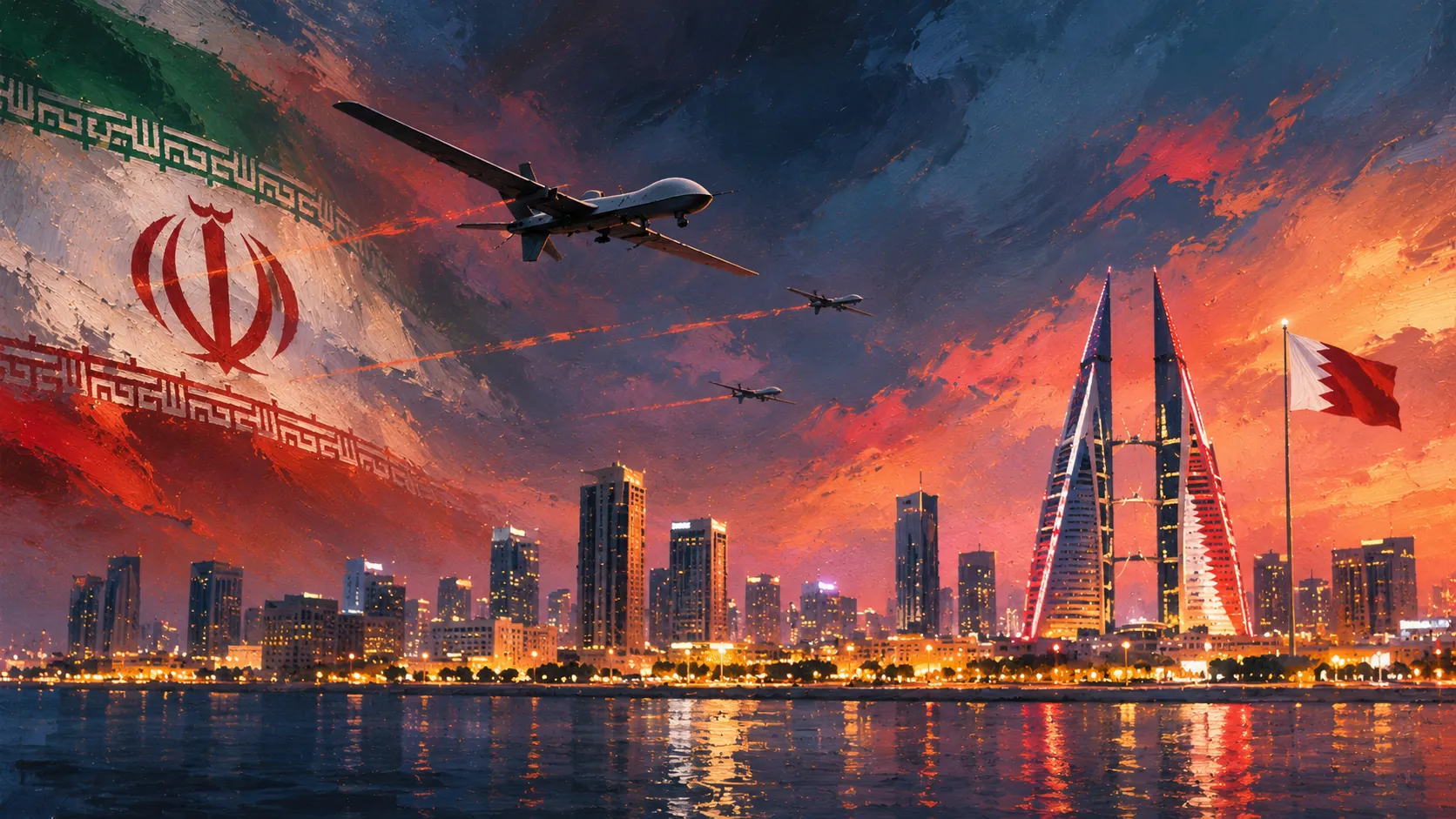
Iran has launched a new wave of aerial attacks towards Bahrain, according to Bahraini and Iranian statements, escalating tensions across the Middle East as the conflict involving Iran, the United States and Israel threatens to destabilise the Gulf.
On Sunday 15 November 2026, Bahrain's Defence Force announced that its air defences had intercepted and destroyed several Iranian aerial threats targeting the kingdom. The announcement followed nationwide security warnings, with residents told to seek shelter as sirens sounded across parts of Bahrain.
Iran's Islamic Revolutionary Guard Corps (IRGC) claimed responsibility for launching six drones at a US air-defence radar installation at the Al-Riffa helicopter base. The reported destruction of the radar has not been independently verified, and neither Bahraini nor US authorities had confirmed that the alleged strike hit its target at the time of reporting.
The incident is another escalation in a regional conflict that began with US and Israeli strikes on Iran in February 2026.
What happened in Bahrain on 15 November?
Bahrain's Interior Ministry issued multiple security alerts early on Sunday morning, with the first reportedly around 4:30 a.m. local time, followed by another as authorities monitored the situation. Residents were advised to stay calm, move to secure locations and rely on official government communications.
The IRGC announced that it had targeted a US military radar installation with six drones. Bahrain's military then confirmed that its air defences had intercepted several incoming aerial attacks. The exact number of drones intercepted, whether any reached their targets and the extent of any damage were not immediately established. Unverified footage circulating online purportedly shows drones over Riffa, but its authenticity has not been confirmed.
Why is Iran targeting Bahrain?
Bahrain hosts the headquarters of the US Navy's Fifth Fleet, which plays a significant role in American operations across the Persian Gulf, the Arabian Sea and surrounding maritime routes. That military relationship makes Bahrain strategically important during any confrontation between Washington and Tehran.
Iran has repeatedly accused the United States of conducting military operations against Iranian infrastructure and has described its attacks on US-linked facilities as retaliation.
It was the second time in three days that the IRGC claimed to have targeted a US radar in Bahrain. On Friday 13 November, the IRGC said it had successfully attacked an American early-warning radar installation. US Central Command rejected the claim, saying American forces had intercepted two Iranian attack drones and that the incident caused no injuries or damage. Iran said its earlier operation was retaliation for what it described as an American strike on a telecommunications installation in Iran's southern Hormozgan province, a claim I could not independently verify.
The competing accounts show how difficult it is to verify battlefield claims during an active conflict.
Bahrain condemns Iranian attacks and calls for international action
Bahrain has strongly condemned the renewed attacks as violations of its sovereignty and threats to regional stability. It has called for international action and urged implementation of UN Security Council Resolution 2817. Bahrain authored the resolution on behalf of the Gulf Cooperation Council states and Jordan. It was adopted by 13 votes to none, with China and Russia abstaining, and it condemns Iranian attacks and any Iranian action aimed at obstructing navigation through the Strait of Hormuz. Iran's UN envoy rejected it as a politically motivated abuse of the council's authority, per UN News.
The Arab Parliament also condemned Sunday's drone attacks and expressed solidarity with Bahrain, stressing the importance of protecting the sovereignty and security of Gulf states. The diplomatic response reflects growing concern that military exchanges involving US facilities in Gulf countries could expose neighbouring states to further attacks.
Could the Iran-Bahrain conflict spread across the Gulf?
The latest developments have raised concerns about wider escalation. Bahrain is not the only country facing security threats. On 15 November, the Saudi-led coalition reportedly intercepted two ballistic missiles heading towards Riyadh and three drones in Saudi Arabia's Eastern Province. Those incidents were associated with the separate conflict involving Yemen's Houthi movement and were not confirmed as direct Iranian attacks. I could not independently verify these reports.
The broader security environment remains fragile. Military activity near major shipping routes, attacks on infrastructure and uncertainty over diplomatic negotiations have raised the risk of further confrontation. A particularly sensitive location is the Strait of Hormuz, through which a large share of the world's oil and liquefied natural gas supply normally passes.
Strait of Hormuz: why the conflict matters to global oil markets
The Strait of Hormuz connects the Persian Gulf to international shipping routes through the Gulf of Oman. Disruption there can have major consequences for global energy markets. Before the conflict it carried about a fifth of the world's oil. UN News, citing UK Maritime Trade Operations, reports that transits are around 65% below pre-conflict levels and that October saw the most incidents since the war began.
Iran's Revolutionary Guards claimed that two oil tankers struck naval mines while attempting to transit the strait on 14 November, and maritime authorities reportedly described an attack involving a tanker sailing towards the strait on Sunday. The details of these incidents were not independently established in the initial reports, and I could not verify them.
Prolonged instability could contribute to:
- Higher shipping and maritime insurance costs.
- Volatility in international oil and natural gas prices.
- Disruption to cargo movements and supply chains.
- Higher operating costs for businesses relying on Gulf shipping routes.
- Greater uncertainty for regional tourism, aviation and investment.
The scale of any economic impact would depend on how long the disruption continues and whether military activity intensifies.
What does the attack mean for the UAE and other Gulf countries?
The UAE, Saudi Arabia, Qatar, Kuwait, Oman and Bahrain are closely connected through regional trade, aviation, energy markets and security relationships. A prolonged confrontation could affect business confidence and cross-border operations across the Gulf Cooperation Council region.
For the UAE, the potential consequences include changes to regional flight schedules, higher logistics costs and uncertainty over international trade. Some UAE airlines were reported to have adjusted selected Saudi routes amid security developments on 15 November, a report I could not verify.
These developments do not mean that every Gulf country faces the same threat or that the whole region is equally disrupted. Businesses and travellers should distinguish between verified government advisories and unconfirmed reports on social media.
US-Iran relations: a conflict with no clear resolution
The renewed attacks come amid stalled diplomatic efforts to end the conflict between Washington and Tehran. The war began in February 2026, when the United States and Israel launched strikes on Iran. Iran subsequently retaliated against US-linked military facilities across the Gulf and attempted to restrict maritime activity through the Strait of Hormuz.
Although the intensity of fighting has fluctuated, the underlying confrontation remains unresolved. US President Donald Trump has reportedly indicated that further military action remains possible if Iran threatens American forces or regional allies, and Iran has said it will respond to attacks on its territory and infrastructure. I could not verify those specific statements. These positions create a difficult diplomatic environment in which single military incidents could trigger further retaliation.
What happens next?
The situation remains unpredictable. Developments to watch include:
- Military response: whether American or Bahraini authorities confirm damage from Sunday's reported drone operation, which could shape later military decisions.
- Regional diplomacy: Iranian Foreign Minister Abbas Araghchi is reportedly expected to visit Oman on Tuesday 17 November for talks with his Omani counterpart, according to Iranian state media (unverified). Oman has often served as a diplomatic channel in regional disputes.
- Maritime security: continued incidents near the Strait of Hormuz could increase pressure on governments to strengthen shipping protection.
- Civilian safety: Bahrain's authorities may issue further security instructions as events develop.
For now, the priority remains preventing further casualties, protecting civilian infrastructure and avoiding a wider regional confrontation.
Conclusion: Iran's Bahrain attacks highlight growing regional risks
Iran's latest drone operations towards Bahrain are a significant escalation in an already volatile conflict. Bahrain has confirmed intercepting several aerial threats, but Iran's claim that it struck American radar infrastructure remains unverified.
The attacks show how the confrontation between Iran and the United States can extend beyond their own territories and affect neighbouring Gulf states. With military activity continuing around strategic installations and major shipping routes, the consequences could reach international energy markets, aviation, trade and investor confidence. Whether the latest incident leads to further retaliation or renewed diplomatic engagement will be a crucial question in the days ahead.
This is a developing story. Military claims, casualty figures and damage assessments will be updated as verified information becomes available.
Sources
Questions
Did Iran attack Bahrain on 15 November 2026?
Iran's Revolutionary Guards said they targeted a US radar in Bahrain with six drones, and Bahrain said its air defences intercepted several Iranian attacks. Neither side's account of damage has been independently verified.
Was a US base in Bahrain destroyed?
No confirmation has been reported. The IRGC claimed a radar at the Al-Riffa helicopter base was targeted, but the US had not confirmed any hit at the time of writing.
Why is Bahrain a target?
Bahrain hosts the headquarters of the US Navy's Fifth Fleet and other US facilities. Iran has described attacks on US-linked sites as retaliation for US actions.
What did the US military say about earlier attacks?
After an IRGC claim on 13 November, US Central Command said it shot down two Iranian drones and reported no injuries or damage. It had not publicly addressed the Sunday claim in the coverage reviewed.
Does this mean Dubai and the UAE are under the same threat?
Not necessarily. Each Gulf state faces different circumstances, so residents and travellers should follow official government advisories and airline updates rather than social media reports.

UAE Weather: Light Rain Possible From Monday After a Windy Weekend With Rough Seas
The NCM forecasts light rain in parts of the UAE from Monday 16 November, after a partly cloudy weekend with strong winds and rough seas in the Arabian Gulf.

US Issues Middle East Security Alert Over Houthi Attacks and Flight Disruptions. What It Means for UAE Residents.
The US Mission to the UAE has urged Americans in the Middle East to be vigilant over Houthi attacks and possible flight disruptions. It names no threat to Dubai.

Sheikh Ahmed bin Rashid Al Maktoum Passes Away at 76; Dubai Declares 10 Days of Mourning
Sheikh Ahmed bin Rashid Al Maktoum, younger brother of Dubai's Ruler and a longtime figure in the emirate's military, police and sporting life, has passed away at 76. Dubai has declared ten days of official mourning.